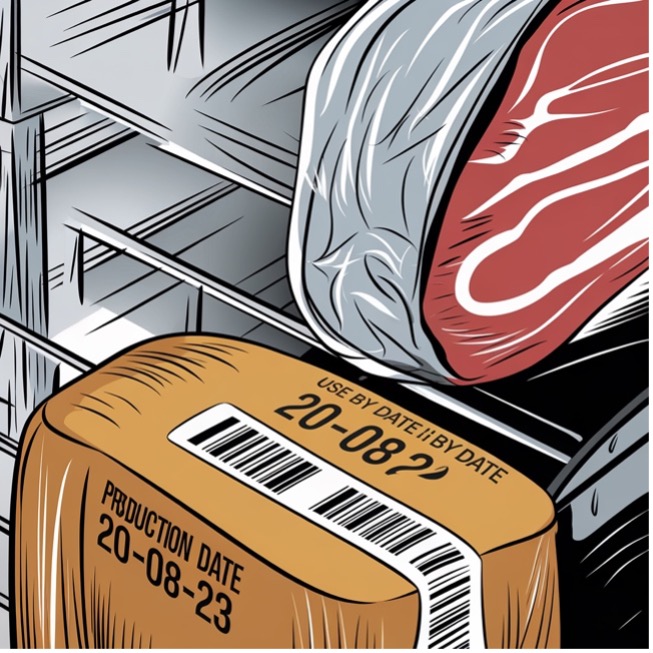
Are you facing challenges with product coding and marking on your production lines? 🤔 In today's industry, accurate and fast product identification has become more critical than ever. Especially on high-speed production lines, traditional labeling methods are no longer sufficient.
Inkjet coding technology has become an indispensable part of modern production facilities. Thanks to this technology, you can perform non-contact, fast, and permanent coding on your products, increasing your production efficiency. ✨ However, there are important points to know to choose the right system and achieve optimum performance.
In this article, we will take a deep dive into the basics of Inkjet coding systems, their advantages, industrial solutions, maintenance tips, and future trends. We will share all the information that will help you choose the most suitable coding solution for your business. 🎯
Basics of Inkjet Coding Systems
Working Principle of Inkjet Technology
Inkjet coding technology works through the precise control of micro-droplets. Ink droplets sprayed at high pressure from the nozzles in the print head perform the coding by contacting the product surface.
Different Types of Inkjet Coding
- Continuous Inkjet (CIJ)
- Thermal Inkjet (TIJ)
- Drop-on-Demand (DOD)
- Piezo Inkjet
Industrial Application Areas
| Sector |
Application Areas |
| Food |
Expiry date, batch code |
| Beverage |
Production date, lot number |
| Pharmaceutical |
Serial number, barcode |
| Automotive |
Part number, QR code |
Basic Components and Hardware
- Print Head: The main unit that performs the ink spraying process
- Ink System: Ink reservoir and circulation system
- Control Unit: Central unit where printer parameters are set
- Sensors: Equipment required for product detection and positioning
Inkjet coding systems are of critical importance for product tracking and traceability in industrial production. They provide uninterrupted and high-quality marking even on high-speed production lines. Let's examine the advantages provided by these systems in more detail.
Advantages of Inkjet Coding
Cost Effectiveness
- Low operating costs
- Minimum consumable consumption
- Use of long-lasting equipment
- Low maintenance costs
| Cost Factor |
Advantage |
| Ink Consumption |
Optimized usage |
| Energy Consumption |
Low power consumption |
| Maintenance Requirement |
Minimal periodic maintenance |
| Spare Parts |
Long-lasting components |
High Printing Speed
Inkjet coding systems have the capacity to mark thousands of products per hour. Modern systems can reach speeds of up to 300 meters/minute on production lines. This speed capacity maximizes production efficiency.
Applicability to Various Surfaces
- Metal surfaces
- Plastic materials
- Glass products
- Cardboard packaging
- Textile products
- Wood materials
Inkjet coding systems provide consistent and clear results even on materials with different surface properties. Thanks to special ink formulations, excellent adhesion is achieved even on rough or glossy surfaces. This versatility offers the flexibility to code on different product lines with a single system.
Considering these strong advantages, it becomes important to examine how industrial marking solutions can be made more efficient.
Industrial Marking Solutions
Production Line Integration
In modern production lines, Inkjet coding systems are vital for continuous production flow. Working in synchronization with automatic conveyor systems, these systems provide precise coding even on high-speed production lines.
Barcode and Serial Number Printing
Basic requirements for product traceability:
- 1D/2D barcode systems
- Serial number coding
- QR code applications
- Variable data printing
Date and Batch Code Applications
To meet food safety and legal requirements, the following information is printed:
- Expiry date
- Production date
- Lot numbers
- Shift codes
| Application Type |
Resolution |
Speed (m/min) |
| Barcode |
300 DPI |
30-60 |
| Date Code |
200 DPI |
40-80 |
| Serial No |
600 DPI |
20-40 |
Special Marking Needs
Industrial marking systems adapt to different surfaces and challenging production conditions:
- Metal surfaces
- Plastic packaging
- Glass products
- Cardboard boxes
Quality Control Systems
Integrated vision